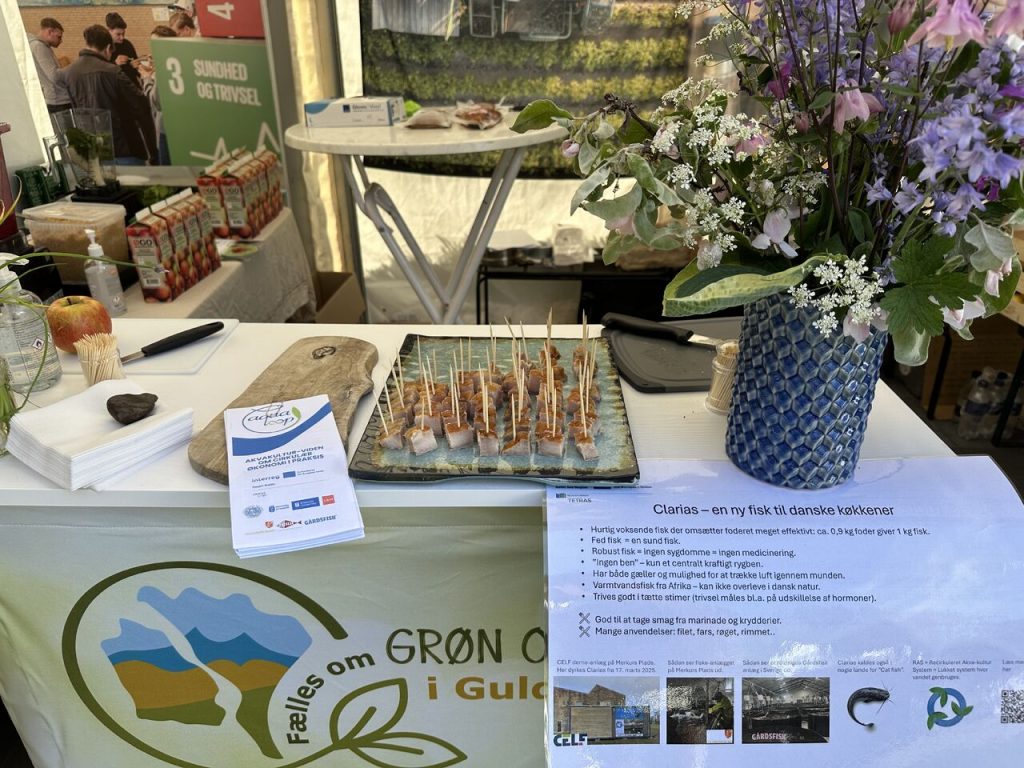
Can fish become a conversation starter? At this year’s Madens Folkemøde (The People’s Food Summit) in Nykøbing Falster, the answer was a resounding yes. As part of the AquaLoop Interreg South Baltic project, representatives from Business Lolland-Falster and Guldborgsund Municipality joined colleagues to introduce visitors to smoked African catfish (Clarias). Over the course of the event, approximately 1,000 tasting samples were served, attracting long queues and enthusiastic feedback from visitors of all ages.
The tastings provided more than just a new culinary experience—they opened the door to important conversations about the future of fish production and food security. Many visitors asked where their fish comes from and how Europe can ensure a more sustainable supply of healthy seafood.
These are timely questions. Fish is widely recommended as part of a healthy diet, yet wild fish stocks are under increasing pressure, and more than half of the fish consumed in the European Union is imported. Developing sustainable, locally produced alternatives is therefore becoming increasingly important. One promising solution is the farming of African catfish (Clarias gariepinus) in Recirculating Aquaculture Systems (RAS). These land-based systems continuously recycle water and nutrients, allowing fish to be produced with high resource efficiency while reducing environmental impacts compared to conventional production methods. Successful commercial production already exists in countries such as Germany, the Netherlands, and Sweden.
Within the AquaLoop project, partners are exploring whether this production model could also create new opportunities on Lolland-Falster. The project investigates the technical, environmental, and economic potential of circular aquaculture systems and aims to identify viable business models that can contribute to regional development, local food production, and greater resilience in the food system.
Madens Folkemøde proved to be an ideal setting for engaging the public in these discussions. Visitors were eager to taste the fish, ask questions, and learn how innovative aquaculture can support a more sustainable food future.
Text and photo credit: Gulborgsund Municipality