
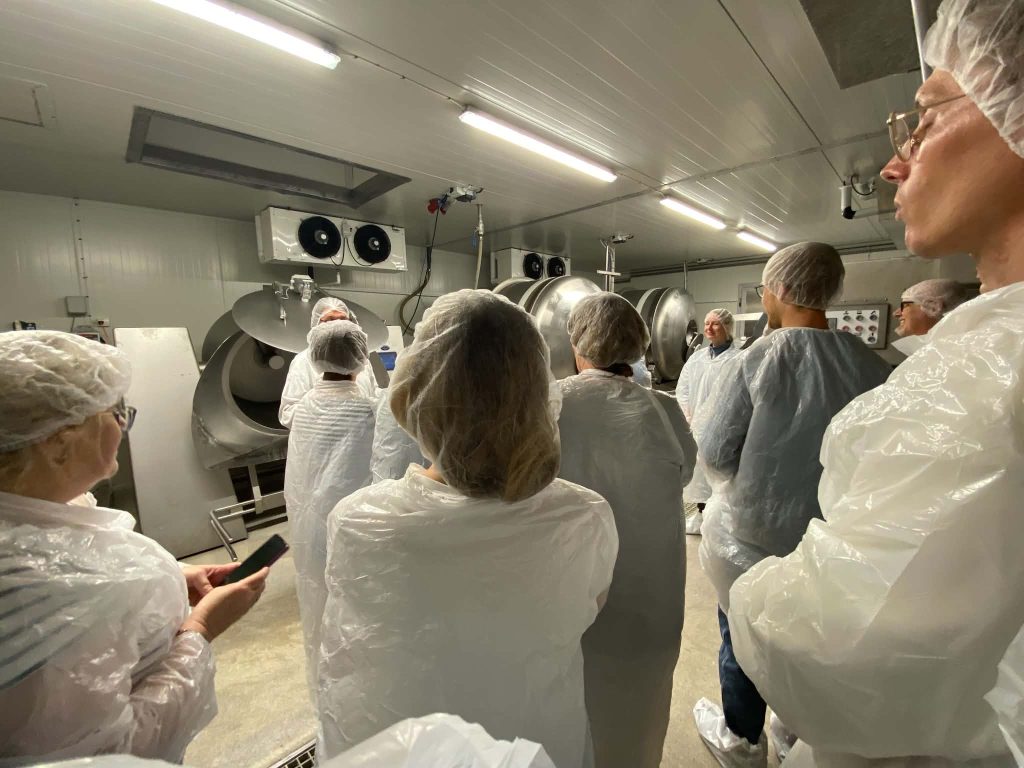
On 10 June 2026 approximately 20 participants from academia, business and stakeholder organizations of the AquaLoop initiative gathered in Malmö for a study visit and workshop hosted in collaboration with Gårdsfisk and Protena Food.
Protena Food is a Swedish food production company specialising in the manufacturing of ready-made products such as meatballs, nuggets, and burgers. The company is part of an innovative and industrial food value chain and provides valuable insight into large-scale, modern food processing and daily production operations. Within the AquaLoop context, Protena Food serves as an important partner for exploring how new raw materials—such as African catfish—can be integrated into established production systems.
The workshop was organised in close cooperation with Gårdsfisk, AquaLoop project partner, a pioneering Swedish aquaculture company working with sustainable fish farming in Recirculating Aquaculture Systems (RAS). Gårdsfisk plays a central role in developing and demonstrating how African catfish can be produced efficiently and integrated into circular food systems, creating value from nutrient loops and side streams.
The day’s workshop, titled “Market Potential for African Catfish”, focused on exploring the opportunities and challenges associated with introducing African catfish to European markets. The programme included: a study visit to Protena Food’s production site in Malmö, insights into daily operations and requirements for food processing industries, presentation on Gårdsfisk operations, how African catfish can function as a in industrial food production, perspectives from the public sector, and online retailers (Mylla.se) on introducing a new fish species to the market by Peter Ferngård, and a final session on the role of RAS systems and local fish production in European contingency planning and food security.
The aim of the day was to highlight the broad market potential of African catfish as an emerging industry species in Europe, while also demonstrating how innovative aquaculture systems and local production can strengthen resilient and future-oriented food systems.
Special thanks to Gårdsfisk for organizing the study visit and workshop, and Protena Food for hosting AquaLoop.