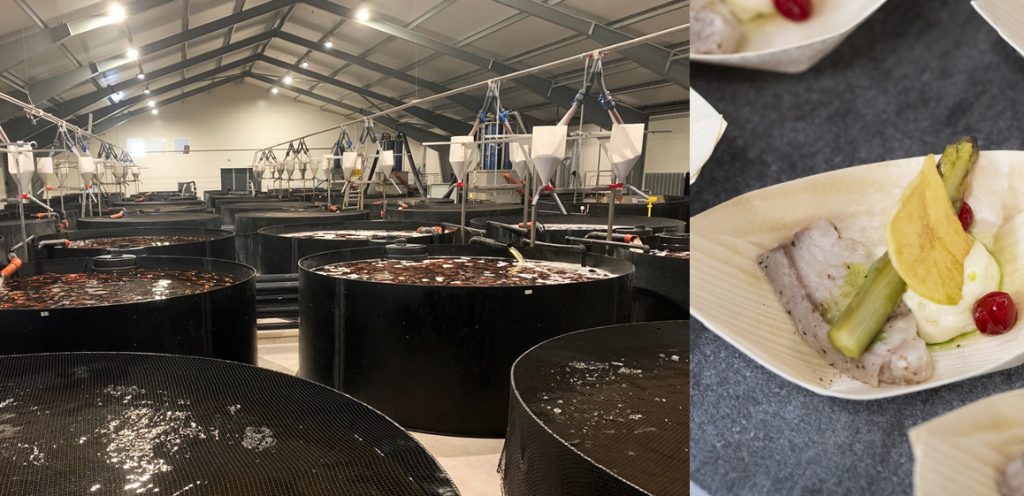
With the AquaLoop project, Guldborgsund Municipality, in collaboration with VKST and the Swedish company Gårdsfisk, is investigating whether it is possible to establish a land-based RAS aquaculture production system (Recirculating Aquaculture System) on an existing farm — while simultaneously integrating the nutrients into the farm’s own circular production system.
The result will be a Danish-Swedish concept and business model describing both the economic and environmental framework conditions.
The cooperation focuses on sustainable methods for handling wastewater and nutrients, in accordance with Danish legislation and environmental requirements — and on what is required to operate aquaculture on land.
As a starting point, Clarias, a robust warm-water fish that tolerates variations in production parameters, does not require medication has been chosen. Through workshops with stakeholders and study visits to commercial facilities and pilot units, AquaLoop partners are gathering knowledge and experience about the opportunities and challenges involved in integrating aquaculture into Danish agriculture.
At the same time, as the environmental authority, Guldborgsund Municipality is gaining valuable insight into the practical and regulatory aspects of establishing indoor fish production and RAS facilities. Since there is no tradition of land-based fish farming in Lolland-Falster, it is crucial to develop and test a solid business model in cooperation with local agricultural organizations and with inspiration from a commercial facility in Sweden.
This model may become the foundation for assessing whether it is relevant and profitable to farm fish as part of agricultural production in Lolland-Falster — thereby opening the door to an entirely new, sustainable food sector in the region.
More on Guldborgsund Municipality’s cooperation and projects – GULDBORGSUND KOMMUNES INTERNATIONALE SAMARBEJDE 2023-2024 report.
Credit (text & photo) : GULDBORGSUND KOMMUNES INTERNATIONALE SAMARBEJDE 2023-2024